
Your Fufu Can’t Taste Good Only on Sundays
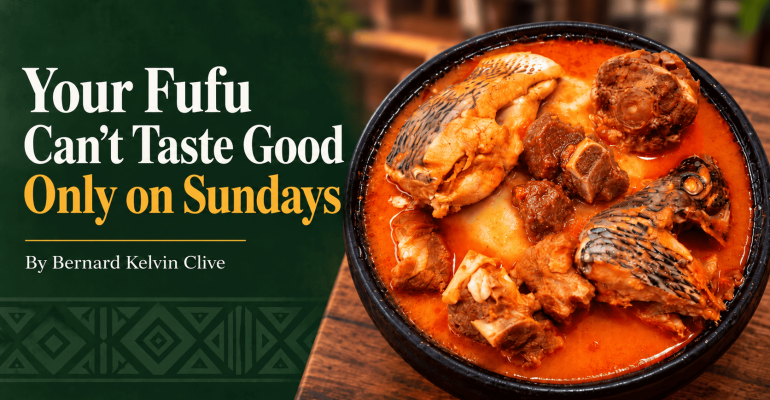
Your Fufu Can’t Taste Good Only on Sundays
 Bernard Kelvin Clive
 Occasionally, a few colleagues and I hang out to eat some good fufu. Once someone discovers a good fufu joint somewhere in town, word goes around, and on a free Saturday or Sunday, or whenever the opportunity presents itself, we make our way there to try it.
Some time ago, one of my colleagues discovered a fufu joint and spoke highly of the place. According to him, the fufu was good, the soup tasted natural, the ingredients were right, and there was none of that artificial feel you sometimes get with food. He had eaten there more than once and was convinced that he had found a good spot, so eventually, I went along with him to try it for myself.
Unfortunately, that day, the food didn’t live up to the hype. Even my colleague admitted that what we were eating wasn’t what he had experienced on his previous visits. The taste was simply off. Well, we laughed about it and excused them. After all, as we sometimes say, it is not every day that the old man’s meal will be superb. Maybe we had simply come on a bad day.
Some time passed, and we tried the place again, but the food wasn’t good. Another visit followed, and the experience was almost the same. At that point, we started wondering whether the place actually served great food consistently or whether my colleague had simply been fortunate enough to visit on their good days.
Later, he discovered another fufu joint. This time, he went there a couple of times and the food was consistently good. Eventually, I joined him, and yes, I could see why he liked the place. Compared to our experience at the first joint, this second place seemed far more reliable.
Some months later, however, we returned and the food wasn’t quite as good as we remembered. Interestingly, we were willing to excuse that experience because there was already a pattern of quality. We had eaten there several times and enjoyed the food, so one disappointing experience didn’t immediately change our opinion of the place. When we returned another time, the food was good again. That experience got me thinking about brands, businesses and the importance of consistency.
How Often Is Your Fufu Good?
With food, several things can affect the final taste. The ingredients available that day may be slightly different, the person preparing the soup may change, the quantity being prepared may increase or decrease, someone may add too much of one ingredient or too little of another, and even the timing can affect the final outcome. All these are understandable, but they also point to a bigger issue.
When the process exists mainly in someone’s head, quality becomes dependent on that person. The measurements are based on experience, the timing is based on instinct, and the person knows exactly when to add something, reduce the fire or make an adjustment. That may work beautifully when the owner or experienced cook is standing beside the pot, but what happens when that person travels, falls sick, employs an assistant, opens another branch or eventually has to hand over the business to someone else?
That is where many small businesses struggle. We have wonderful local chop bars and restaurants producing some of the best meals you can find anywhere. Sometimes, however, what is missing is the ability to translate that excellence into a process that another person can understand, learn and repeat. The recipe may be excellent, but if the system behind it is weak, consistency will eventually suffer.
Consistency Builds Trust
Think about some of the more standardized restaurants and food businesses. They try to reduce the number of things left entirely to chance by establishing measurements, recipes, preparation procedures, quality checks and clear expectations about how the food should look, taste and be served. This doesn’t mean they will get everything right every single time, because no business does, but they have created a system that helps them keep the experience within an acceptable standard regardless of who happens to be working that day.
That is something every business can learn from.
I know of a local food joint in Accra that some colleagues have patronized for many years. What interests me about this particular place is that even as different people have become involved in preparing the food and running the business, they have largely maintained the taste and experience people have known them for over the years. Somehow, the knowledge has been transferred and the people who came after the original hands have been able to maintain what made the place worth visiting.
To me, that is an important sign of business maturity. You should be able to pass on the baton without losing the recipe.
What Is Your Business Recipe?
Your business may have nothing to do with food, but you also have a recipe. A graphic designer has a process for receiving a client’s brief, developing concepts, presenting the work, handling corrections and delivering the final files. A school has a way parents should be received, children should be taught, complaints should be handled and progress should be communicated. A consultant has a process for diagnosing a client’s problem, developing solutions, communicating recommendations and following up. Even if you sell products through WhatsApp or social media, there is a process from the moment someone makes an enquiry until the product reaches the customer.
The important question is whether that recipe has been documented and can be followed by someone else, or whether everything depends on you and a few experienced people in the business.
If you are unavailable, can another person deliver close to the same quality? Can customers still experience the standard they have come to associate with your name? Can you open another branch without destroying what made the first one successful, and can the business grow without the quality dropping significantly? These questions matter because customers don’t experience your intentions; they experience what you actually deliver.
Don’t Build a “Sometimes Good” Brand
One excellent experience can attract a customer, but consistent experiences are what build trust and keep people coming back. There will always be bad days. An ingredient may fail, a supplier may disappoint you, a staff member may make a mistake, technology may fail or something completely unexpected may happen. Most reasonable customers understand that.
The danger begins when inconsistency becomes normal, and customers cannot tell whether they are going to receive an excellent experience, an average one or a disappointing one when they deal with you. After a while, they stop trusting the promise of the brand because they are never quite sure which version of the business they are going to meet.
This is why small businesses must take systems seriously. Document what works, write down the recipe, define the process, train people, establish minimum standards, create simple checklists and review what goes wrong so that the same mistakes are not repeated. You don’t need to become a huge corporation before doing these things. In fact, putting these systems in place is part of what gives a small business the capacity to grow without losing the quality that made people love it in the first place.
Your brand should not depend entirely on whether you are present, whether your best employee came to work or whether everyone happened to be in a good mood that morning. The goal is to move as much of your excellence as possible from the heads and hands of individuals into processes that can be taught, followed, improved and repeated.
So, take a good look at your business and identify the things you do very well but have never properly documented, the areas where quality still depends heavily on one particular person, and the parts of the customer experience that could easily change if that person left. Then determine what must remain consistent regardless of who is serving the customer.
Whether you sell fufu, books, consulting services, clothing, technology or education, the principle is the same. Don’t build a brand that is excellent only occasionally. Build the processes and culture that make quality repeatable, because customers should not have to wonder whether today happens to be one of the days when your fufu will taste good.
Remember, I am your Branding and Publishing Consultant.
The best is yours.
