
Before You Hand Over the Keys
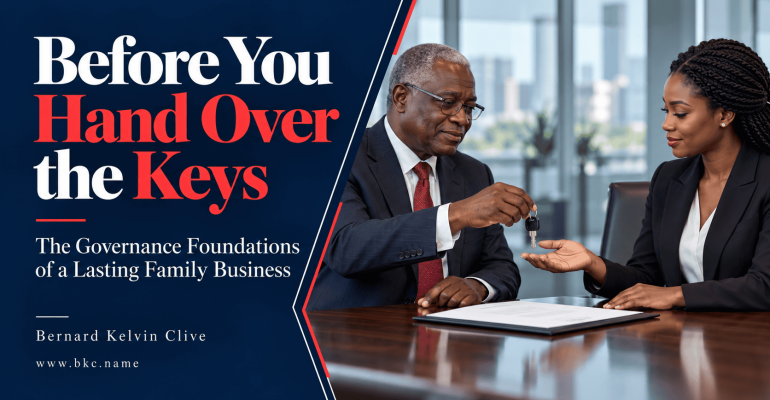
Before You Hand Over the Keys
 Bernard Kelvin Clive
The Legal and Governance Foundations of a Lasting Family Business
I have noticed something about many business owners, especially those who have spent decades building their companies. They work very hard. They dream of leaving something meaningful for their children. Some even bring their children to the office during school holidays and involve them in family discussions, so they can learn how the business works.
These are good intentions. But there is one important question many owners cannot answer. How exactly will the children take over what has been built, and under what arrangements?
I have met business owners who tell me confidently that their businesses belong to their children. When I ask how they plan to transfer ownership or management, the conversation becomes very interesting. Some believe that because the children carry the family surname, the matter is settled. Others expect the eldest child to take charge when they are no longer around. A few have promised different portions of the business to different family members. Meanwhile, there is no proper documentation, no board, no clear succession plan, and nobody knows who has the legal authority to make decisions when the founder is not there.
Imagine a businessman in Accra who has spent thirty years building a manufacturing company. He has four children. The first is a medical doctor with little interest in the business. The second works in the financial sector and offers advice from time to time. The third has worked in the company for fifteen years and understands almost every part of it. The youngest is still at university, but he already tells his friends that the company belongs to the family and that one day he will be CEO.
The father loves all four children and wants each of them to benefit from his labour. But should each child get equal ownership? Should they all become directors? Should the one who has worked in the business for fifteen years automatically become the chief executive? What about the operations manager who has served faithfully for twenty years and knows the company better than any of the children? And what happens if the children disagree about the direction of the business after their father is gone? You see, these are hard questions. Parental love alone cannot answer them.
One lesson I have learned from studying businesses that survive their founders is this: family relationships and business responsibilities are not the same thing. A child may have a right to the wealth a parent created, but that does not mean the child is qualified to run the business. In the same way, a person can be good at managing a business without owning it. If we do not understand this difference, we may spend years building a business only to leave confusion for the very people we wanted to bless.
Your Children Can Own the Business Without Running It
Think of a family that owns a chain of supermarkets. The founder wants the business to stay in the family for generations. That is a good ambition. But keeping the business in the family does not mean every family member must work in it every day. The family can keep the shares and hire qualified professionals to run the operations, with proper oversight.
It helps to understand the roles. Shareholders own shares in the company. Directors provide governance and oversight. Management runs the business day to day within the authority given to it. In small businesses, one person may play all three roles. Still, the roles are not the same.
At the REBRAND Masterclass on business legacy and succession, Samuel Koranteng Adjei of Nyansa Institute spoke on corporate governance. He stressed the importance of separating ownership, board responsibilities and management.
In many of our businesses, the founder is the main shareholder, the managing director, the board chairman, the chief negotiator and the final authority on everything. This may look efficient while the founder is strong and available. The trouble starts when the founder retires, falls ill or dies. Suddenly, nobody knows where one person’s authority ends and another person’s responsibility begins.
Good governance solves this. It sets out how decisions are made, who can make them, who supervises management and how people are held accountable. It also makes room for professional skill, so that family members do not occupy positions only because of their relationship with the founder.
I would rather see a family keep a thriving business run by competent professionals than watch an unprepared relative slowly destroy it.
When the Family Business Meets the Law
Many business owners do not fully understand the difference between what they own personally and what belongs to their company.
Say you set up a limited liability company, and it buys vehicles, equipment and buildings. You may have started it, provided the first capital and made most of the big decisions. Still, the company’s property and your personal property are legally separate. Owning shares in a company does not mean you personally own every asset registered in the company’s name.
Lom Nuku Ahlijah, Esq., spoke about this at the REBRAND Masterclass. He explained why proper legal planning, clear ownership arrangements and good documentation matter.
So, when a business owner says, “I have given the business to my children,” what exactly has been given? Have the shares been legally transferred? Have the company records been updated? Are there other shareholders whose rights must be considered? Is there a shareholders’ agreement that controls how shares can be transferred? Does the founder’s will match the real ownership structure?
In Ghana, the Companies Act, 2019 (Act 992) provides the legal framework for company administration, directorships and corporate governance. Other laws, such as the Wills Act, 1971 (Act 360) and the Intestate Succession Law, 1985 (PNDCL 111), may also apply when an estate is being administered. How these laws apply depends on the situation, so you need professional legal advice.
My main point is that succession planning must start while you are alive, mentally fit and active in the business. Waiting for a family dispute before you look at the legal structure is a very expensive way to learn a lesson.
Give Your Children a Path, Not Just a Position
Bringing children into a family business takes wisdom. You may truly want a son or daughter to lead one day, but the process must be deliberate.
Let the child learn how the business works. Let them understand its customers, finances, staff, challenges and responsibilities. Where it makes sense, let them work under experienced professionals and slowly take responsibility for results they can be measured on. Their growth should depend on competence and character, with proper employment and management arrangements in place.
The transition must also be documented. When children are appointed as directors, receive shares or take up management roles, the right legal and corporate steps must be followed. These roles carry responsibilities and, sometimes, legal duties. A directorship is more than a nice title on a business card.
I have always believed that the founder’s greatest duty is to prepare the people and structures that will carry the business forward. This is at the heart of the Grooming and Succession parts of my G.R.A.S.S. Legacy Framework. Grooming is about developing people. Succession is about the planned handover of responsibility and authority. The two must work together.
Protect the Business from Avoidable Family Conflict
Family conflict is a threat many owners underestimate. People who love each other can fight bitterly when money, property and power come into the conversation.
One child may want to sell. Another may want to expand. A third may demand regular dividends whether or not the company can afford them. A surviving spouse may have real concerns about financial security.
Depending on the business, the right legal tools may include shareholder agreements, properly written wills, clear governance policies, documented decision-making authority, ways to settle disagreements, and arrangements for transferring or buying out ownership interests. A family may also write a family constitution that sets out shared values, expectations and rules for taking part in the business. But it must work together with binding legal documents. It cannot replace them.
For smaller businesses, the starting point can be simple. Keep your company records in order. Know who owns what. Set clear roles. Keep financial records. Decide who can act when you are not available. Then get qualified professionals to review your legal position and help you put the right arrangements in place.
The Conversation You Must Have While You Can
The hardest part of succession planning is that it forces us to talk about things we would rather delay. Retirement, illness, death, inheritance and family disagreement are not cheerful topics for a Sunday family gathering. But ignoring them does not make them go away.
If you truly want your business to outlive you, you must be ready for conversations that may first make people uncomfortable. Explain your intentions to those who need to know. Get professional advice. Document the arrangements and review them as things change.
The people who will inherit your assets should not spend years in court trying to understand what you meant. And the employees who helped you build the company should not be left without direction because nobody prepared for leadership.
Your duty as a founder goes beyond collecting assets and naming an heir. It includes creating the conditions in which the business can keep creating value after you step away.
So, before you hand over the keys, make sure the people receiving them understand the responsibility. Make sure the company has the right governance in place. And make sure you’ve properly considered the law.
A legacy should give the next generation something solid to build on, not a complicated problem to untangle.
Get the book ‘Beyond You’ visit www.bkc.name/rebrand
The best is yours.
