
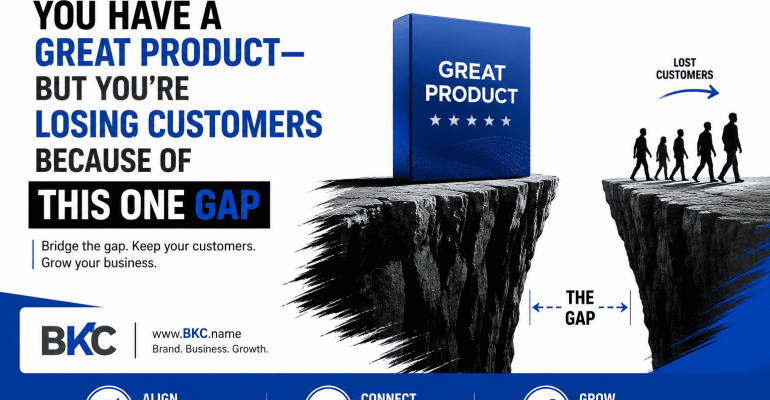
You Have a Great Product — But You’re Losing Customers Because of This One Gap
You Have a Great Product — But You’re Losing Customers Because of This One Gap
 Bernard Kelvin Clive
 Let me tell you something that should bother every business owner in Ghana right now.
You can have the best product on the market. A stunning brand identity. A slick website. A social media presence that turns heads. And still be losing customers, not to a competitor with a better product, but to a competitor with a better response time.
The gap I’m talking about is not a product gap. It is not a pricing gap. It is a customer relations gap, and it is costing African businesses a fortune every single day.
I know this not just from research or theory. I know it from personal experience and from watching too many brands I respect lose business they should never have lost.
The Dentist Who Never Called Back
Not too long ago, I needed dental services. I went online, saw some well-designed ads running on social media, three different dental practices, all of them clearly investing in their digital presence. Professional looking. Credible. I was impressed enough to reach out to all three via WhatsApp.
I sent my name. Explained my needs in detail. Mentioned the specific issue I’d been trying to resolve. I even noted what previous practitioners had advised. I was a warm lead. An easy conversion. I had already made up my mind to book; I just needed someone to respond like they cared.
What I got instead was an automated message: “Hello! How can we help you today?”
I called one of them. Explained everything again my name, my issue, my history. “We’ll get back to you,” they said. They never did.
The next day, I followed up on WhatsApp. The same automated message greeted me as if we had never spoken: “Hello! How can we help you today?”
The second practice asked for my location, said they’d follow up, and went silent.
I eventually found a third option — one that responded promptly, treated me like a person, and earned my business. The first two practices are still running those ads. Still spending money to attract customers they are not equipped to keep.
The Relationship Manager Who Manages Nothing
This is not limited to small businesses or startups. I have seen the same pattern in some of our most established financial institutions.
A colleague recently shared his frustration with his bank’s relationship manager — a person whose entire job title is built around the word “relationship.” Yet every interaction felt like an imposition. Every request was met with reluctance, delay, or a reminder that they were doing him a favour.
I have had the same experience with two local banks. You call them for something straightforward, and the energy on the other end tells you that you are the problem — not the person they are paid to serve.
This raises a question that every business leader must sit with: do you actually know what is happening at the client-facing layer of your business? Are you listening to those calls? Are you reading those chat logs? Or do you consider the job done once the client signs on?
The Real Problem: Complacency Dressed as Confidence
Research consistently shows that a significant number of local businesses across the country struggle with customer care and client relations. But here is the uncomfortable truth: it is not always ignorance. Often, it is complacency.
The business owner who has built a reasonable client base starts to believe that the work is done. There are enough customers. The pipeline is full. So, when a new enquiry comes in — timid, unassuming, maybe small — it does not receive the same energy as the big client in the room.
That is a dangerous and expensive mistake.
That quiet enquirer you dismissed could be a referral machine. That small first transaction could be the beginning of a five-year relationship. You simply do not know who is walking through your door — and that is exactly why every single person deserves to be treated with intention and respect.
Word-of-mouth marketing — what we might also call relationship marketing — remains one of the most powerful growth engines for any brand. One person treated well tells three others. One person dismissed tells ten. And in the age of social media, that number multiplies fast.
The Numbers Don’t Lie: Retention Is Cheaper Than Acquisition
It costs significantly more to acquire a new customer than to retain an existing one. Studies vary on the exact multiple — some say five times more, others say up to seven — but the principle is consistent: the customer already in your ecosystem is your most valuable asset.
Which means that every time a client leaves because they felt ignored, undervalued, or poorly treated, you are not just losing a sale. You are losing the future value of that relationship, the referrals they would have made, and the goodwill they would have spread in your name.
And then you spend marketing budget trying to replace them. It is a cycle that quietly bleeds businesses dry.
What Good Customer Relations Actually Looks Like
Let me be practical. Customer relations is not just about being polite. It is a system. And like every system, it requires intentional design.
Here is what it looks like when it is working:
- Know who you are talking to. When a person sends you a message, their name and context should be captured and accessible. If they follow up the next day, the conversation should continue — not restart. A simple CRM, even a well-managed spreadsheet, can solve this.
- Acknowledge promptly, even if you cannot resolve immediately. A human response that says, “Hi Kofi, I have seen your message and I am looking into this — I will get back to you within the hour” is worth more than the best automated reply. It signals that a real person is paying attention.
- Follow through without being chased. If you say you will call back, call back. If you said you would send information, send it. Nothing erodes trust faster than a promise not kept. Nothing builds it faster than follow-through that was not expected.
- Collect feedback and act on it. Build simple review mechanisms into your client journey. A quick post-service WhatsApp message. A short Google Form. A direct conversation. Then actually use what you hear to improve. Let your clients see that their voices shape your service.
- Train your team as if the business depends on it — because it does. Your front-line staff are your brand. The way they speak, respond, and follow up is the lived experience of everything you claim to stand for. Invest in that training the way you invest in your product.
Technology Is a Tool, Not a Replacement for Care
Automation has a role. Chatbots, autoresponders, email sequences, CRM dashboards — these are powerful tools, and I encourage every business to use them. But they are support systems, not substitutes for human attention.
The dental practice that sent me the same automated greeting three times had the technology. What they lacked was the discipline to use it well — to log the conversation, flag the follow-up, and ensure that no enquiry fell through the cracks.
Here is a simple audit you can run today:
- How long does it take your team to respond to a new enquiry? Time it.
- What happens when a lead follows up? Is there a system, or does it depend on who is online?
- Do you have a record of every client interaction — their needs, their questions, their pain points?
- When was the last time a client complained, and what did you do about it?
- Are your automated messages building rapport or just ticking boxes?
If the answers make you uncomfortable, that discomfort is your roadmap.
Your Competitor Is Just a Click Away
I say this often because it remains true: in today’s market, your competitor is just a click away. The person who reached out to you this morning and received no meaningful response by afternoon has already Googled three alternatives. They are not being impatient — they are being rational.
The brands that will win in the next decade will not necessarily be the ones with the biggest budgets or the most sophisticated products. They will be the ones that make people feel genuinely seen, heard, and valued — consistently, at every touchpoint.
That is not a soft, optional extra. That is strategy.
Where Do You Go From Here?
If you are a small business owner, a startup founder, a brand manager, or a CEO reading this — today is the day to take this seriously. Not next quarter. Today.
Audit your customer touchpoints. Fix the broken ones. Retrain your team. Set up systems that ensure no enquiry goes unanswered. Follow up on every lead like it matters — because it does.
And whatever tools and technology you deploy newsletters, CRM software, WhatsApp Business, email automations never let them replace the human touch that turns a transaction into a relationship.
Do get my latest book online ‘The CEO, the Customer & the Culture’.
Available on Amazon
Great products build curiosity. Great customer relations build loyalty. And loyalty builds a business that lasts.
The best is yours.
