
Don’t Automate the Soul Out of Your Business
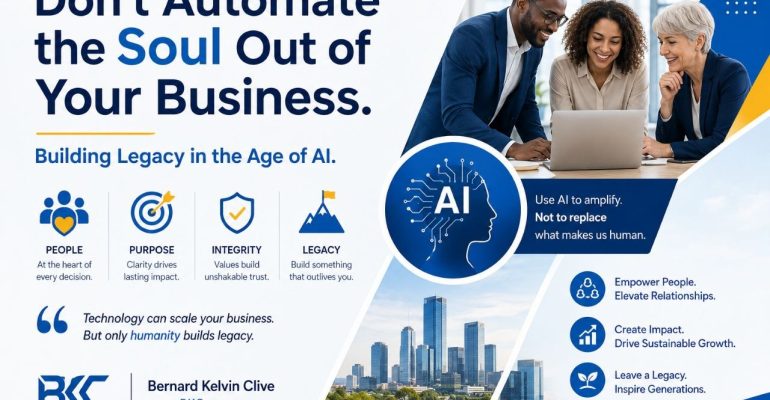
Don’t Automate the Soul Out of Your Business
 Bernard Kelvin Clive
 Building Legacy in the Age of AI
Today, I am still thinking about legacy building in brands and businesses, especially in this era where automation, AI tools, systems, dashboards, bots, and devices are helping businesses move faster, serve better, and innovate across many sectors.
I believe in technology. I use it. I recommend it. I teach people to take advantage of it because no serious business can afford to ignore the tools available today. AI can help you write faster, analyse data, serve customers, track inventory, manage payments, create content, train staff, and reduce the heavy burden of repetitive work. For many entrepreneurs, this is a blessing. For growing businesses, it is a gift.
But as we rush to automate, there is one quiet question many business owners may not be asking well enough.
Who will understand the business after the tools have done the work?
That question may look simple, but it carries the weight of legacy.
A business can run on systems, but legacy runs through people. A brand can use AI, but it must still carry human judgment, values, memory, culture, and direction. If we automate everything and fail to groom people who understand the roots, reasons, processes, mistakes, and decisions behind the business, we may build fast businesses that cannot last.
The Speed of AI Is Good, But Speed Alone Does Not Build Legacy
Many businesses are using AI already. According to McKinsey’s 2025 global AI survey, AI use has become common across organizations, and many companies now use generative AI in at least one business function [1]. The World Economic Forum also reports that employers expect 39% of workers’ core skills to change by 2030 as technology reshapes work [2].
This means the world of work is shifting quickly. The way we hire, train, sell, communicate, manage operations, and serve customers will not remain the same. A small business that once needed five people for some tasks may now use one person with the right tools. A company that used to take two weeks to prepare reports can now generate drafts in minutes. A brand that depended only on physical meetings can now reach thousands of customers through automated platforms.
This is good.
But we must not confuse speed with strength.
A business may move fast and still have weak roots. A founder may automate the customer service process, the accounting process, the marketing process, and even the training process, but if no human being understands how the whole thing works together, the business becomes a machine without memory.
That is where the danger begins.
When the founder is around, everything may seem fine. The founder knows why the system works that way. The founder knows which customer needs special handling. The founder knows why one supplier must never be ignored. The founder knows the story behind a pricing decision. The founder knows the mistakes the business made ten years ago and why certain things should not be repeated.
But when the founder steps aside, travels, becomes ill, retires, or passes on, what happens?
If all the knowledge sits in the founder’s head and all the operations sit inside tools, then the next generation inherits passwords, platforms, subscriptions, and dashboards, but not wisdom.
Legacy needs more than login details.
Automation Without Human Grooming Creates a Leadership Gap
Let us assume a company has existed for twenty years. Over the years, the business has grown steadily. It has customers, staff, suppliers, records, a name in the market, and a way of doing things. Then AI tools enter the picture. The owner starts automating marketing, invoicing, content creation, customer support, reporting, and some operational tasks.
For a while, everything looks beautiful. Costs reduce. Output increases. Work becomes faster. The business looks modern.
But five or ten years later, a new question appears. Who now leads the business into the next phase?
Who understands the old system and the new system?
Who knows what must remain human and what can be automated?
Who can challenge the AI output when it looks correct but does not fit the company’s values?
Who can make a judgment call when the dashboard says one thing, but experience says another?
That is why businesses must groom people alongside systems. Every serious founder must start thinking beyond automation. You need young people, team members, apprentices, managers, and successors who can grow with the business. They must not only know how to use tools. They must understand the thinking behind the tools.
A young person in the business must know why the brand speaks in a certain tone. They must know why the company does not cut corners. They must know how customers were won, how trust was built, how mistakes were corrected, how money was handled, how partnerships were formed, and how the business survived hard seasons.
AI can process information, but humans must carry interpretation.
This is why leadership development should not disappear because automation has arrived. In fact, automation makes leadership development more important. When tools become powerful, the people who guide them must become wiser.
A poorly trained person with powerful tools can damage a brand faster than a slow manual system ever could.
Documentation Must Now Include Decisions, Not Only Processes
Many businesses document processes. They write down how to issue receipts, how to open the shop, how to handle customer complaints, how to process orders, how to create reports, and how to manage inventory. That is good.
But in the age of AI, documentation must go deeper.
We must document decisions.
A process tells people what to do. A decision record tells them why it was done that way.
For legacy building, the “why” matters. If you only document the steps, the next leader may follow them blindly. But when you document the reasoning, they can adapt the business intelligently when the market changes.
For example, a business may use AI to recommend prices. That is useful. But the business must also document the pricing philosophy. Are we a premium brand? Are we serving low-income families? Do we compete on speed, quality, trust, convenience, or exclusivity? When discounts happen, what must never be compromised? Which customers do we protect? Which values guide our pricing?
Without this kind of documentation, the next manager may let a tool drive decisions without understanding the soul of the business.
McKinsey’s research shows that high-performing AI organizations pay attention to leadership ownership, talent, operating models, data, adoption, scaling, and human validation of AI outputs [1]. That point matters. The best organizations are not just throwing tools into the business. They are building structures around how people use those tools.
That is what legacy-minded businesses must do.
Do not only document how to use the software. Document how the business thinks.
Do not only record passwords. Record principles.
Do not only train people to click buttons. Train them to make wise decisions.
The Future Business Will Need Human Judgment More, Not Less
Some people think AI will remove the need for human judgment. I disagree. AI will remove some repetitive work, yes. It will reduce manual pressure, yes. It will help teams work faster, yes. But it will also increase the need for judgment.
Why?
Because when machines produce more options, humans must choose better.
When AI generates ten strategies, someone must know which one fits the brand.
When automation handles customer complaints, someone must know when a matter needs human warmth.
When reports come from dashboards, someone must know what the numbers do not say.
When competitors use the same tools, human originality, trust, culture, and relationships become stronger differentiators.
PwC’s 2025 Global AI Jobs Barometer analysed close to a billion job ads and found that AI-related skills are growing across industries, while workers with AI skills are attracting stronger wage premiums in many markets [3]. That means the future will not favour people who ignore AI. But it will also not favour people who only know how to prompt tools without understanding business, people, ethics, markets, and leadership.
The future will favour those who can combine tools with taste, speed with wisdom, and automation with accountability.
This is where African businesses must pay attention. We have many founder-led businesses that carry deep knowledge, but that knowledge often sits with one person. The founder knows the customers. The founder knows the supplier network. The founder knows the community. The founder knows how to negotiate, when to be firm, when to be patient, and when to walk away.
If we add AI to such a business without documenting the founder’s wisdom and grooming successors, we may only make the business look modern on the outside while it remains fragile inside.
The African Development Bank has projected that AI could add $1 trillion to Africa’s GDP by 2035 if used to enhance productivity, but the same report points to enablers such as data, compute, skills, trust, and capital [4]. I like the word “skills” there. Tools alone will not deliver the future. Skilled people must carry the tools.
So, as African entrepreneurs, we must not only ask, “Which AI tool should I use?”
We must also ask, “Who am I training to understand this business deeply enough to lead it when the tools change?”
Because tools will change. Platforms will change. Today’s best software may become tomorrow’s abandoned app. But a well-groomed person with business understanding can learn new tools and still protect the brand.
Build Systems, But Also Build People Who Can Carry the Systems
Legacy is over and after.
That is one of the ways I like to think about it. Legacy is not only what works while you are present. Legacy is what continues with meaning after your direct involvement reduces.
So yes, build systems. Automate what should be automated. Use AI where it brings clarity, speed, and efficiency. Remove unnecessary manual stress. Let technology help you serve better. Let it help you reduce waste. Let it help you compete.
But while you build systems, build people.
Let young people sit in meetings, not only to take notes, but to understand how decisions are made. Let them shadow leaders. Let them ask questions. Let them learn the history of the business. Let them understand the mistakes. Let them know the values. Let them handle real responsibilities gradually. Let them use AI tools, but also let them explain the reasoning behind their outputs.
A business that wants to last must create a bridge between the old wisdom and the new tools.
This is where many founders struggle. They want the business to continue, but they do not open the inner room of the business early enough. They keep everything close to their chest. They wait until they are tired before they begin succession conversations. By then, the young people around them may know how to operate the software, but they may not know how to carry the spirit of the brand.
Legacy does not happen by accident.
You must plan it. You must document it. You must groom for it. You must review it. You must make room for people to grow into leadership before the need becomes urgent.
The business of the future will not be fully human in its operations, and it will not be fully automated in its leadership. It will need both. It will need tools that work and people who think. It will need dashboards and discernment. It will need systems and stories. It will need speed and soul.
So, as we embrace AI, let us not automate away apprenticeship. Let us not replace grooming with subscriptions. Let us not mistake a chatbot for a successor. Let us not build a business where machines know the process, but no human understands the purpose.
Because at the end of the day, the question is not only whether AI can help your business grow.
The bigger question is this:
After the tools have done their part, who will carry the business forward?
Think about this.
Sources used for the data points: McKinsey State of AI 2025 (McKinsey & Company), World Economic Forum Future of Jobs 2025 (World Economic Forum), PwC Global AI Jobs Barometer 2025 (PwC), African Development Bank AI in Africa projection (afdb.africa-newsroom.com).
