
What a Little Girl Carrying Bamboo Taught Me About Building a Brand
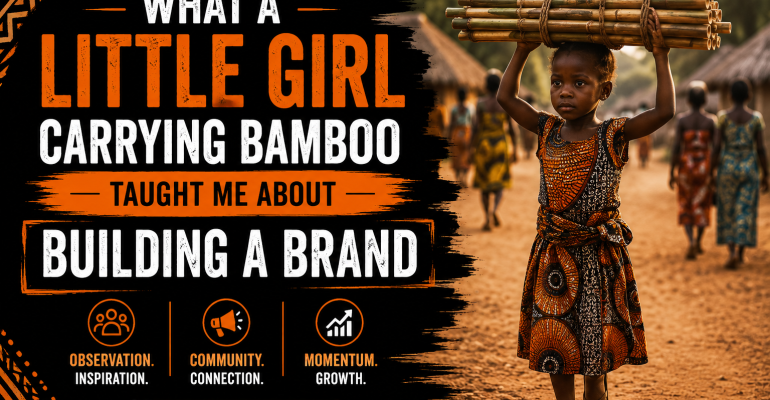
What a Little Girl Carrying Bamboo Taught Me About Building a Brand
 Bernard Kelvin Clive
 I was riding through the village to visit my grandparents when I stopped dead in my tracks.
Not because of traffic. Not because of anything urgent. But because of a little girl — maybe four or five years old — who had picked up a small bundle of bamboo and placed it carefully on top of her head.
She was following the older women. Watching them carry their loads the way they had always done. Step by step, head held high, arms slightly out for balance. She wanted to do exactly what they were doing.
The load fell. She picked it up. Placed it on her head again. It fell again. She picked it up. Again.
I stood there longer than I needed to. I was supposed to keep riding. But I couldn’t move. Because I realized I was watching one of the most powerful lessons in human behavior unfold right in front of me — and it had everything to do with how brands grow, how movements are built, and how people are led.
The Learning Nobody Teaches You
What that little girl was doing has a name. Psychologists call it observational learning, or social modeling. It is the process through which people — especially children — acquire behaviors, values, and habits not through direct instruction, but simply by watching others.
She never had a lesson on how to carry a load. Nobody sat her down and explained posture, weight distribution, or balance. She simply saw the adults around her doing it, day after day, and something inside her said: I want to do that too.
This is how much of human behavior actually works. Not through manuals. Not through training sessions. But through observation, desire, and imitation.
And here is the critical thing for every entrepreneur, brand builder, and business owner reading this: the same psychology that moves that little girl is the same psychology that moves your customers.
People don’t just buy products. They buy what they see others doing, wearing, celebrating, and belonging to.
The Bandwagon Is Not a Gimmick — It Is Human Nature
Go on social media on any given day. You will find a fundraiser that has already raised significant money, a challenge that hundreds of thousands of people are participating in, a hashtag that has taken over the conversation. And here is what you will also notice: the more people that are already participating, the faster new people join.
This is what behavioral economists call the bandwagon effect. When people see that a large number of others are doing something — buying a product, supporting a cause, joining a community — they feel an almost magnetic pull to join. Not always because they have examined the evidence and made a rational decision. Often, simply because everyone else is doing it.
You may call it herd mentality. You may call it FOMO — the fear of missing out. You may shake your head at it. But dismissing it does not make it go away. It is a fundamental feature of how human beings navigate uncertainty. When we do not know what to do, we look at what everyone else is doing. And we do that too.
The little girl at the village was not carrying bamboo because someone told her it was a good idea. She was carrying it because everyone around her was doing it. And belonging to the group — moving with the tribe — felt more important than the weight on her head.
What Brands That Understand This Look Like
Think about the last time you walked into a shopping mall and saw a group of twenty or thirty people, all in matching yellow T-shirts, moving together and drawing attention. Something happened in you, didn’t it? Your neck turned. Your eyes followed. You wanted to know: what is this about? Who are these people? What are they doing?
That is not an accident. That is a calculated activation of exactly the psychology we have been discussing. Brands and organizations that understand social modeling do not just advertise — they create visible, attractive, irresistible communities of people who make others want to belong.
You see it with the biggest brands in the world. People do not just wear a swoosh on their sneakers — they belong to something. They do not just drink a particular coffee — they have an identity around it. They do not just use a phone — they are part of a tribe that sees the world a certain way.
The brand itself almost becomes secondary. What matters is the cohort — the visible, energized group of people moving in the same direction. When enough people move together, they generate gravity. And gravity is what pulls everyone else in.
You are not just selling a product. You are creating a movement that makes people want to get on board before it passes them by.
Social Engineering for Good — How to Build Your Cohort
Now let us bring this home. You have a business. Maybe it is small. Maybe you are still building it. Maybe you are at the beginning stages of trying to get people to notice what you do. And you are wondering: how do I create this kind of pull? How do I trigger the bandwagon effect for my brand?
Here is the thing — you do not need a massive budget. You need strategy, patience, and the right understanding of human behavior.
Start with your most passionate customers or supporters — what some marketers call your early adopters or brand evangelists. These are the people who already believe in what you are doing. Give them something to do together, something visible, something that signals membership. A shared language. A signature color. A hashtag. A challenge. A ritual. Something that when others see it, they immediately want to know what it is about.
Then amplify those people. Celebrate them publicly. Show the world that people just like your potential customers are already on board, already benefiting, already part of something meaningful. You are not just showing off a product — you are showing off a tribe. And that tribe, when visible enough, becomes the most powerful advertisement you will ever have.
This is why testimonials work. This is why user-generated content outperforms polished advertising. This is why the most effective marketing today is not a brand speaking about itself — it is real people, in real numbers, moving in the same direction.
There Are Levels to This — Do Not Rush the Process
Here is where many young entrepreneurs make a costly mistake. They see a brand that has reached icon status — where the name alone triggers emotion and loyalty — and they try to manufacture that overnight. They throw money at paid campaigns trying to fake volume. They buy followers. They create the appearance of movement without the substance.
It does not work. Or rather, it works for a moment and then collapses. Because people can feel the difference between a real movement and a performance of one.
Real brand gravity is built in stages. First, you serve a few people remarkably well. Those people become believers. Believers become advocates. Advocates start moving together, talking together, and their collective voice begins to attract others. Over time, the cohort grows. The movement becomes visible. And what was once a small operation starts to pull people in without you having to push.
The little girl was not trying to carry a full load. She picked up what she could carry. She tried. She fell. She tried again. And somewhere in that village, years from now, another little girl will watch her carry that same load effortlessly — and will pick up her own bundle and try.
That is the cycle. That is how culture is created. And culture, once created, is the most powerful brand asset you will ever own.
Your job is not to manufacture hype. Your job is to build something real enough that people cannot help but tell others about it.
The Observation That Changes Everything
So let me leave you with this question — the same one I turned over in my mind as I finally rode on past that little girl in the village.
Who is watching your brand right now? What are they seeing? Is there a visible, energized community of people around what you do — a community that makes an observer want to put down their own concerns for a moment and ask: what is this about? Can I be part of it too?
Because that is the goal. Not just awareness. Not just clicks. Not a campaign that runs for two weeks and vanishes. The goal is gravity. The goal is a movement that grows because people see others in it and want in.
The research tells us that social proof is one of the most powerful drivers of human decision-making. What that means practically is that you do not need to convince every customer individually. You need enough people moving together that the movement convinces people for you.
Start small. Be consistent. Celebrate your early believers. Make them visible. Give the tribe something to rally around. And then watch, with patience and intention, as gravity begins to do the work.
Yes, and finally, if you found this valuable and want to explore more on branding, positioning, and strategic growth, you can find my books online by searching for Bernard Kelvin Clive. And if you’d like to engage me for speaking, coaching, or training, reach out through my official channels.
The best is yours.
