
The Mechanic Who Refused to Be Left Behind – Innovation!
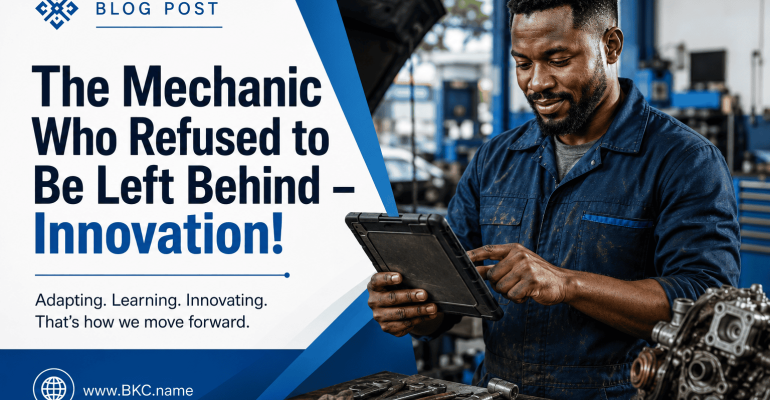
The Mechanic Who Refused to Be Left Behind – Innovation!
 Bernard Kelvin Clive
 It’s Still Not Too Late to Innovate
There’s a mechanic – vulcanizer in my neighborhood who unusually implemented a business strategy. And he doesn’t even know it.
I’ve spent a good amount of time talking about innovation, creativity, technology, and AI, and why brands, whether you’re a fresh startup or an establishment with years behind you, cannot afford to be left behind. Not because change is fashionable, but because the market simply will not wait for you to catch up. The good news, and the point of this piece, is that catching up is still possible. It’s still not too late to innovate.
The Mechanic Who Refused to Be Left Behind
Some time back, I shared the story of an auto mechanic in my area who had been using the same tools and the same methods for close to twenty years. Nothing had changed about how he worked, even though a few meters down the road, a new fuel station had sprung up, kitted with newer tools and technology that could do the same job faster and with far less effort.
I passed by his shop again after a while, and what I saw, was like wow! Impressed. He hadn’t reinvented himself overnight, but he had clearly moved. You see, in his growing neighborhood, more people had taken to riding motorcycles, the tricycles we call Pragya, and other motorbikes. Instead of sticking rigidly to fixing tires and pumping air for cars alone, he had quietly expanded into repairing motorcycles, tricycles and Pragyas too.
He now has a bigger shed. He’s not just changing tires anymore; he’s fixing engines across a wider range of vehicles that his community actually uses. That is growth. Not the kind that happens overnight, but the kind that happens because someone paid attention to what was changing around them and adjusted.
What struck me most is that he didn’t abandon who he was to get there. He’s still the mechanic he’s always been. He simply widened his lane to reach more people, because the market itself was widening. More people in his area were choosing motorbikes and tricycles over cars, and rather than watch that shift pass him by, he leaned into it.
That’s the lesson for every business owner reading this. Sometimes we miss the first wave of change. Maybe we were too comfortable, too cautious, or simply too busy to notice. But missing one wave doesn’t mean you sit on the shore and watch every wave after it roll past you too. There’s usually a second wave, and a third. The question is whether you’ll be ready when it comes.
Growth Happens in Layers, Not Leaps
One thing I want you to notice about this mechanic’s story is that his growth didn’t happen in one giant leap. It happened in layers.
First, he stayed with what he knew, fixing tires, changing them, pumping air for cars. Then he noticed the tricycles coming in more frequently and realized the mechanics behind them weren’t entirely foreign to him. Almost the same principles, just applied to a different frame. So he learned. Then the motorcycles followed the same pattern, and he adjusted again.
This is how real growth tends to work in business, whether you’re running a digital brand or a brick-and-mortar shop. You don’t need to overhaul everything you do overnight to stay relevant. You need to look honestly at what’s shifting in your market, identify the parts of that shift that connect naturally to what you already do well, and take the next logical step.
Too many of us wait for the perfect moment to make one dramatic transformation, and in doing so, we miss dozens of smaller opportunities to adjust along the way. The mechanic didn’t wait until he had mastered every kind of vehicle repair before he started. He started with what was closest to his existing skill, then built outward from there, one layer at a time.
Ask yourself: what is the equivalent of the tricycle showing up at your shop? What adjacent need is emerging in your market that isn’t a complete departure from what you already do, but simply an extension of it? That’s usually where your next phase of growth is hiding.
Over the years, I’ve seen what real, quiet growth looks like. It’s like the trainer who loves their classroom but starts filming short videos for social media. Because they can feel the pull of an audience waiting on their phones somewhere remote. It’s a natural, gentle stretching of what they already do. Like a mechanic who quietly moves from cars to motorbikes, building on what they already know.
Yet, so many of us freeze. We convince ourselves that to grow, we have to burn everything down and start over with a brand-new identity. That fear keeps us stuck in place, waiting for a flash of perfect clarity that never actually comes. You don’t need a complete reinvention. You just need to trust what is right in front of you, and have the quiet courage to take one honest step.
Know When to Bring In the Skillset You Don’t Have
Here’s the part of the story I find most instructive. As this mechanic’s work grew, he didn’t try to do it all alone. He brought his brother on board. He brought in other people too.
This is a important lesson for every business owner and every brand builder. There comes a point in every growth journey where you have to pause and ask yourself: do I need an extra hand right now? Do I need a partnership? Do I need someone with a skillset I simply don’t have, so I don’t have to reinvent myself from scratch just to keep up?
You might have the vision. You might have the managerial foresight to see where the business needs to go. But vision without implementation stalls. You need people who can execute what you can see. Sometimes that means bringing in someone younger, a Gen Z team member perhaps, who comes with a fresh perspective and a different relationship with technology and trends. Sometimes it means partnering with someone whose strengths complement the gaps in your own.
The mistake many businesses make is waiting too long to ask this question, or worse, refusing to ask it at all because of pride or the fear of losing control. But growth almost always requires collaboration at some stage. You don’t have to know everything. You don’t have to build everything yourself. You have to know when to bring in the right hands and the right minds to help you scale what you’ve already started.
Reassess your growth at every level. That’s not a one-time exercise; it’s an ongoing discipline. At each stage, ask what kind of support this next phase demands, and be honest about whether you currently have it in-house or need to go find it.
Sometimes, many founders confuse holding on tightly with staying in control. They believe that bringing someone else in, whether a partner, an employee, or a collaborator, somehow dilutes what they’ve built. But control isn’t about doing everything yourself. Control is about being clear on your vision and choosing the right people to help you execute it well. The mechanic didn’t lose his shop by bringing his brother in. If anything, he gained the capacity to serve more customers without burning himself out trying to fix every tricycle and every motorbike alone.
This is especially important as your brand or business begins to reach into new territory. The skills that got you to where you are now may not be the same skills that will get you to where you’re going next. That’s not a failure on your part. That’s simply how growth works. A brand that started as a one-person operation eventually needs someone to handle what the founder can no longer manage alone, whether that’s finance, content, technology, or customer engagement. Recognizing that need early, rather than waiting until you’re overwhelmed, is what separates businesses that scale from those that stall under their own weight.
Building Your Own Innovation Map
So how do you actually put this into practice in your own business or brand? You sit back and you draw a map.
Look honestly at the changing needs of your market. What are the current trends? What is shifting in the behavior of the people you serve? Then ask yourself where you can plug in. What would that plugging in actually require of you? Who would you need to bring on board to make it happen? And most importantly, how would you resolve your customers’ problems effectively and efficiently while staying true to your niche and relevant in your market?
This is the strategy work that too many businesses skip. We get comfortable doing what has worked, and we assume that because it worked before, it will keep working indefinitely. But the market doesn’t stand still, and neither should our thinking.
I want you to think through this simple concept the mechanic demonstrated without ever calling it a strategy. He didn’t hold a boardroom meeting or commission a market research report. He simply paid attention, adjusted in layers, and brought in help when the growth demanded it. That’s a strategy every business, digital or physical, can apply.
Whether you’re a growing brand, a startup finding its feet, or an established name that has been doing things one way for years, there’s still room for you to grow, still room for innovation, still room for creativity. Yes, you’ve done things a certain way for a long time, and that’s fine. The question now is simply this: what can you add on? What can you adjust? What can you do differently to stay relevant, grow your brand, and continue reaching the clients who need what you offer?
Don’t wait for a dramatic overhaul before you move. Start with what’s closest to you, the tricycle at your doorstep, so to speak, and build outward from there. Bring in the right people when the growth calls for it. Keep reassessing as you go.
It’s still not too late to innovate.
If you need any of my branding books and resources, search my name, Bernard Kelvin Clive, anywhere digital goods are sold online. Download, share, buy copies, and let me know what you think.
If you’d like to book me for speaking, coaching, or consulting, visit my website at www.BKC.name or reach me directly at bernardkelvinclive at gmail.com.
The best is yours.
