
The Customer Culture: The Business You Are Losing Daily
The Customer Culture: The Business You Are Losing Daily
 Bernard Kelvin Clive
 “Too many businesses treat a brand promise as a line used to get people through the door, something to be quietly renegotiated once the customer is already committed and has nowhere convenient to go.”
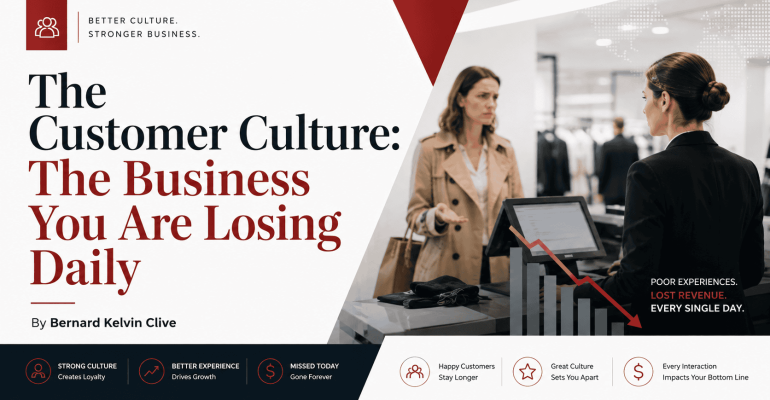
Today, I want to talk about customer connection — the culture that drives a business, and what it really says about how you’re doing. Not what your billboard says nor what your last social media campaign says. What the person walking through your door, or driving into your forecourt, or dialing your line, experiences in that moment.
Let me share a couple of stories with you. They’re not unusual, in fact, typical of what happens in far too many of our local businesses. Because a number of us have simply stopped paying attention to the customer, to the customer experience, to what actually goes into keeping someone who has chosen, deliberately, to do business with us. We spend so much energy getting people to notice us. We spend far too little energy on what happens once they arrive.
When the Customer Walks In and No One Sees Them
I drove into a fuel station recently to pick up something to eat for the road. I walked in, and nobody attended to me. No one said “come this way,” no one directed me to where I needed to go. The attendants were simply sitting there — some of them busy on their phones. You have been employed to work. Customers are driving in, walking in, looking for direction. Show them the right place. But there was nothing of that sort. It felt like they were doing me a favour by even being present. And this has not happened to me once. I’ve seen it, in various forms, at various places, across this nation, more times than I can count.
Contrast that with what you’ll notice at some fuel stations and washing bays. There are broadly two types of attendants. The first type comes to you quickly, ready to help, ready to pack your things and see you off — that is the right approach, and it makes all the difference in how you feel about that brand. The second type is what you find at places where you drive in and the attendants are busy washing other cars, or doing something else entirely, and nobody comes near you. Nobody directs you to park. Nobody attends to you for five minutes. I remember sitting at one such place for a while, deciding eventually to reverse and leave. As I was pulling out, of course, someone suddenly came alive — “chairman, senior, come in, come this way.” By then, I had already gone. They lost that sale. They may have lost me as a customer entirely.
That story reminded me of one a friend shared with me. He had travelled to another part of the country for a training assignment and stopped at a restaurant he had seen promoted on Facebook. The moment he walked in, the aroma was inviting, the setting looked good — everything about the marketing had done its job. He sat down with his team. And then, for three to five minutes, nothing happened. No waitress came to the table to ask, “How can we help you?” The staff were simply behind the counter, going about their own business, as if the people who had just walked in didn’t exist.
You know what, I disagree, fundamentally, with how we run some of our businesses. We need business. When people walk into our offices, our restaurants, our shops — on purpose, deliberately choosing us over every other option available to them — that has to be our first priority. We do not leave them standing there to eventually walk away. And yet this is happening across a great many businesses that simply don’t pay attention to the customers, the clients, or the would-be clients who walk through their doors, because everyone inside is “busy” doing something else. This, to me, is one of the real and recurring challenges facing a number of local businesses today: you can have a great billboard, a strong social media presence, all the right adverts pulling people in — but the moment there is actual human interaction, the moment someone calls your line or steps into your space, the whole experience falls apart. That is one of the biggest gaps in customer relations that I see repeatedly: the attendants, the receptionists, the frontline staff meant to carry the customer cycle forward, are simply not present in the way the business needs them to be. They are physically there, doing “their work,” but not truly attending to the one thing that pays their salary.
This is exactly why I always tell CEOs and business leadership teams: put your ears to the ground. Occasionally, do your own mystery shopping. Drive in as a stranger would. Call your own customer lines the way an ordinary customer would. Walk into your own outlet unannounced and see how your people actually relate to someone they don’t recognise. Don’t sit comfortably in the boardroom, or at the back office, assuming everything out front is going well. If you never check, you are losing business daily — quietly, invisibly — not necessarily because your product is wrong, but because the people representing you at the point of contact are not paying attention to the very people keeping the lights on.
Broken Promises Cost More Than They Save
Let me share another story — this one about the value of a customer, and what it truly means to keep a brand promise once you’ve made it.
Sometime back, a cousin of mine enrolled her children in a school with a standing policy: bring your third child — your third sibling — and that child receives a 50% discount on tuition. It’s a smart, generous policy on paper. It rewards family loyalty, and in exchange for discounting one child’s fees, the school secures three enrolments from a single household. That is a strong trade for any business, education or otherwise.
My cousin enrolled her third child under that clear promise. After the first term, the discount had quietly slipped from 50% down to about 20%. No explanation. No conversation. It was simply reduced, as if the original commitment had never been made. By the third term, it had fallen again, to roughly 10%. When she mentioned this to me, I told her plainly: that is not right. A business must keep its brand promise. And if there is a genuine challenge on the business’s side — rising costs, a change in circumstances, anything at all — they owe the customer an honest conversation about it, not a silent, unexplained erosion of what was promised.
I got involved directly. I reached out to the school and told them, without mincing words: you cannot break a brand promise like this. You are receiving three enrolments — three children, three sources of goodwill and referral — from one family, on the strength of a promise you made publicly. What did it actually cost you to acquire that family in the first place — the advertising, the open days, the positioning, everything it takes to get a parent to trust you with their children? And now, over a discount worth a fraction of that acquisition cost, you are willing to risk losing all three children to a competing school down the road?
That is really the question every business must sit with: what will it cost you to simply honour the promise you made, compared to what it will cost you to lose that client altogether, along with everything they might have brought you — referrals, reputation, repeat business, years of tuition? Too many businesses treat a brand promise as a line used to get people through the door, something to be quietly renegotiated once the customer is already committed and has nowhere convenient to go. But we own our promises. Paying close, consistent attention to the people already doing business with us is not a nice-to-have. It is the business.
Why Keeping a Customer Is Worth More Than Chasing a New One
This is not only a values argument. It is an economic one, and the numbers back it up firmly. Research popularised by Harvard Business Review has shown that acquiring a new customer can cost anywhere from five to twenty-five times more than retaining an existing one, and analysis from Bain & Company found that increasing customer retention by just 5% can lift profits by 25% to as much as 95%, depending on the industry you’re in. Existing customers are also far more forgiving, far more likely to try what’s new from you, and far more likely to spend more per visit than a first-time buyer you’re still trying to convince.
Think about what that means for the stories I’ve shared. That family my cousin enrolled — three children, already convinced, already inside your system, already paying — was worth protecting far more cheaply than that school realised. The fuel station losing a customer over five minutes of neglect isn’t just losing one visit; it’s losing every future visit, every referral, every quiet recommendation that customer might have made to a colleague or neighbour. Every business owner pouring money into new leads on social media while quietly losing the customers already inside the building is fighting the wrong battle, and paying more for it than they need to.
What Great Brands Do Differently
Great brands listen to their customers. They don’t wait for a formal survey or a crisis to find out something is wrong. They learn from the friction points — the complaints, the silences, the small, easily dismissed disappointments — and they leverage that learning to get better, quickly and visibly. That’s really the whole discipline in three words: listen, learn, leverage. What can we do, starting this week, to keep the people who have already chosen us? If you do this consistently, deliberately, and without waiting to be forced into it, you sustain your business, you grow your brand organically, and you become genuinely top of mind in the industry you’re trying to lead — not because your adverts said so, but because your customers are saying so, to each other.
So today, go back and look honestly at your own process — as a CEO, a salesperson, a marketing lead, or an SME owner building something from the ground up. What am I missing? Where am I failing to give the people who trust us an experience worth returning for? Where am I ignoring a concern, or brushing off a complaint, simply because I’ve convinced myself the business is fine without addressing it?
For all of us — SME leaders, business owners, brand custodians — customer experience and customer culture are not soft issues to be handled whenever there’s time. They sit right at the centre of whether our businesses survive, grow, or quietly bleed out one lost customer at a time.
Before you move on to the next thing on your list, do one of these this week:
- Go undercover in your own business. Call your own customer line as a stranger would, or walk into your own outlet unannounced. Note exactly how long it takes before someone truly attends to you — not just greets you, attends to you.
- Pull up every promise you’re currently making to customers — discounts, guarantees, service commitments — and check, honestly, whether you are still keeping every one of them in full.
- Ask three existing customers one question: “Is there anything we promised you that we haven’t fully delivered on?” Then actually listen to the answer, and fix what needs fixing.
- Brief your frontline team this week — the receptionists, the attendants, the waitstaff — on one simple standard: every person who walks in gets acknowledged within the first thirty seconds. Measure it. Don’t assume it’s happening.
Small as these steps sound, they are the difference between a business that quietly loses customers and one that keeps building on the ones it already has.
If you’d like to go deeper into this subject, you’ll find my book on customer culture and business on Amazon — search for my name, Bernard Kelvin Clive. My latest works, The CEO, The Customer and The Culture of Lasting Business available there.
Let me know how this has been helpful to you.
Remember, I’m your brand and publishing consultant.
The best is yours.
