
They Named It!
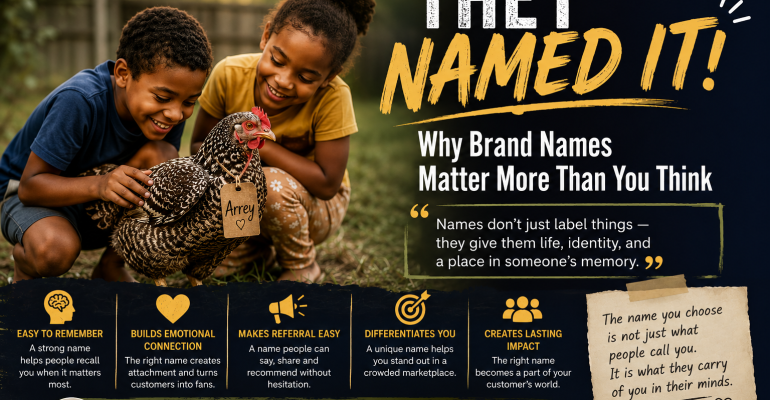
They Named It!
 Bernard Kelvin Clive
 Why Brand Names Matter More Than You Think
Let me tell you something my kids taught me — completely by accident — that I haven’t been able to stop thinking about in terms of branding and business.
We have neighbours who keep rare, exotic chickens. A beautiful bird, a cross-breed you don’t see often around here. One day, one of those chickens somehow found its way over the fence and into our compound. We tried to coax it back. We tried guiding it toward the gate. The thing simply refused to move. It just walked around, pecking at the ground, completely unbothered, acting like it had been living with us all its life.
We didn’t stress too much about it. We figured we’d let the neighbour know and get it sorted. But then the kids came home from school.
That changed everything.
They spotted the chicken and immediately went into full excitement mode — chasing it gently, offering it water, watching it strut around. By the next morning, the chicken was still there. Day two, same thing. Day three, same. Our neighbour knew the bird had crossed over, but it seemed content to stay. And the kids? The kids had fully adopted it.
Then one evening, I overheard a conversation between my two children. One of them said something like, “Let’s go and see Arrey.” I stopped. I thought they were talking about going somewhere or seeing someone. I came out and asked what was happening, reminding them they weren’t going anywhere at that time of day. They laughed and said, “Dad, we’re not going anywhere. We’re going to see Arrey. The chicken.”
They had given the chicken a name.
Arrey. Not “the chicken.” Not “the bird from next door.” Not “that thing in the yard.” A proper name. A specific, chosen, deliberate name. And with that name came a whole new world. Suddenly the chicken had a personality in their conversations. It had a story. They could refer to it, remember it, talk about it to others, and feel a connection to it that no generic description could have created.
“Names don’t just label things — they give them life, identity, and a place in someone’s memory.”
How Children Understand What Brands Need to Learn
Here is what struck me the most: our neighbour raised those chickens. He feeds them, tends to them, and has had them for years. But as far as I know, none of them had individual names. They were chickens — a category, not individuals.
My children, in three days, gave one of those chickens an identity that neither the owner nor the bird’s original environment had provided. And from that moment, it wasn’t just a chicken. It was Arrey.
Children do this instinctively. They name their toys, their stuffed animals, their imaginary friends, even their fears. They name things so they can hold them, remember them, and make meaning out of them. I noticed that almost every toy in our home has a name. They don’t refer to “the red car” or “the big bear.” Each one has its own name, and in the world of their play and imagination, those names carry weight.
As adults in business, we sometimes forget this instinct. We get so focused on product specs, service descriptions, and category labels that we neglect the one thing that transforms a product from a commodity into a brand — the name.
Think about it. What’s more powerful: “a search engine” or “Google”? “A streaming service” or “Netflix”? “A ride” or “an Uber”? The category explains what something is. The name gives it a world.
What a Name Actually Does for Your Brand
A name is not decoration. It is not an afterthought. A name is the first act of brand identity — it is the anchor around which everything else is built.
Research in branding and consumer psychology consistently shows that brand recall — the ability of a customer to bring your name to mind without any prompting — is directly connected to purchasing decisions. When someone is asked to name a fast-food restaurant, a cola brand, or a courier service, the names that come up first win the sale. Not the ones with the most features. Not the ones with the lowest price. The ones that are remembered.
According to brand awareness studies, most consumers can only spontaneously recall between three and five brand names in any given product category. That is your competition for space in a customer’s memory. The name you choose, and how well you build around it, determines whether you make that short list.
A strong name does several things at once. It signals what you stand for. It triggers an emotional response. It simplifies the conversation a customer has to have when recommending you to someone else. And critically, it makes it easier for people to come back to you — because they can actually find you in their own memory.
Think about when you’ve referred a business to a friend. What did you say? “There’s this place — I can’t remember the name exactly, but they do…” versus “You have to try XYZ.” The first is a weak referral. The second sells. The name is what makes word-of-mouth work.
“The name you choose is not just what people call you. It is what they carry of you in their minds.”
The Emotional Weight of the Right Name
There is something else my children showed me that goes beyond memory. When they named that chicken Arrey, they started caring about it differently. They checked on it in the morning. They talked about it at the dinner table. They were upset when the neighbour finally found a way to lure it back home.
A name creates attachment. And attachment is what drives loyalty.
This is not just childhood psychology — it is human psychology. When something has a name, we relate to it differently. We invest in it emotionally. We feel a sense of familiarity and connection that a product description alone can never create.
In branding, this emotional dimension is everything. Apple doesn’t just sell computers — it sells a sense of identity. Coca-Cola doesn’t just sell a drink — it sells a feeling of happiness and togetherness. Nike doesn’t just sell shoes — it sells the story of what you could become. And every one of those experiences starts with a name — a name that over time has been loaded with meaning, memory, and emotion.
When you name your business or product well, you give your customers something to carry with them. A reference point. A feeling. A conversation starter. A name they reach for without thinking when they need what you offer.
And when you name it poorly — or not at all — you leave them with nothing to hold on to. You become “that company” or “you know, those people who do the thing.” You become forgettable, even if your product is excellent.
Naming Is a Business Decision, Not a Creative Exercise
I have spoken before about rules and principles in brand naming — including the rule of three that I have shared in previous pieces. Today I want to anchor on something even more foundational: the decision to take naming seriously in the first place.
Many businesses treat naming as an afterthought. They pick something available, something easy to spell, or something that just “sounds fine.” And then they spend years trying to build equity into a name that is working against them rather than for them.
A name that is hard to pronounce creates friction. A name that means something unintended in your customer’s language creates confusion. A name that is too generic fails to differentiate. A name that sounds too similar to a competitor creates legal and brand clarity problems.
But a name that is clear, memorable, emotionally resonant, and authentic to what you do? That name becomes an asset. It compounds over time. Every customer interaction, every marketing campaign, every referral adds value to it. You are not just building a product or a service — you are building something people will remember and return to.
Before you launch, before you print the business cards, before you build the website — ask yourself: what feeling do I want this name to trigger? What does it say about who I serve and how I serve them? Will my ideal customer be able to say it, remember it, and pass it on to someone else?
These questions are not trivial. They are strategic. And getting them right, especially early, saves you from an expensive rebrand down the road.
Lessons from Arrey
The chicken eventually went back home. Our neighbour secured the fence and Arrey — as my kids still call it — is no longer a resident of our compound. But the lessons? Those stayed.
My children, without any knowledge of branding or marketing, demonstrated something that the world’s most successful companies have invested millions to achieve. They took something ordinary — a wandering chicken — and gave it an identity. They made it memorable. They created attachment. They built a story around a name.
And that name made all the difference in how they related to it, talked about it, and remembered it.
As you think about your business, your product, your service — think about this: does it have a name that works as hard as you do? Does it give your customers something to hold? Does it make it easy for them to remember you, return to you, and refer you?
Names map things to memory. Names trigger emotion. Names give identity to the ordinary and turn the ordinary into something people care about.
My kids taught me that. Arrey taught me that.
Now — what have you named yours?
The best is yours!
Yes, and finally, if you found this valuable and want to explore more on branding, positioning, and strategic growth, you can find my books online by searching for Bernard Kelvin Clive. And if you’d like to engage me for speaking, coaching, or training, reach out through my official channels.
The best is yours.
Podcast: Play in new window | Download
